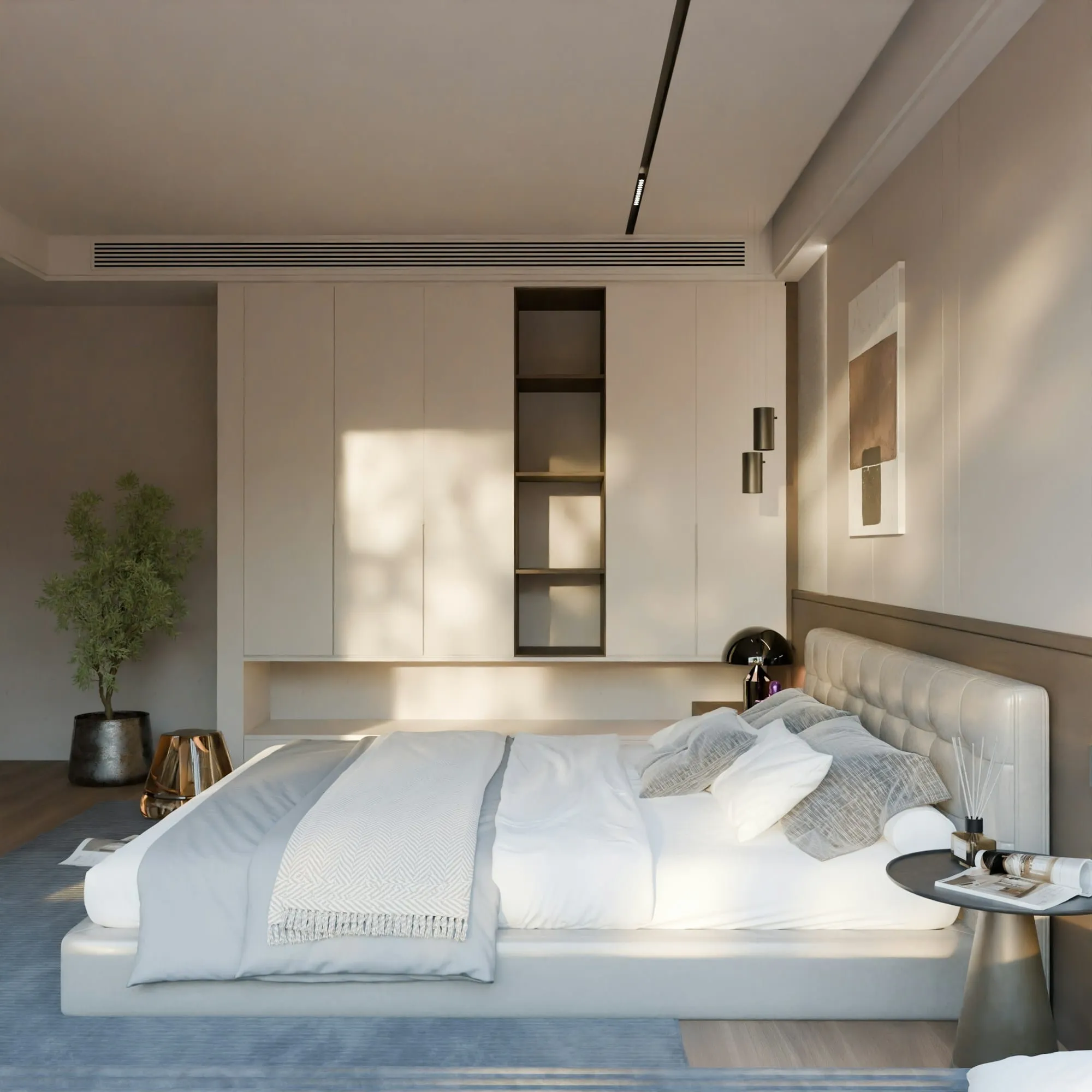
東East-facing bedroom
Where to put the bed in an east-facing bedroom
Direct sun from about 6am to about 11am. The rest of the day is shade.
An east-facing bedroom catches the day’s first light, often before an alarm goes off. The window becomes the room’s most active feature rather than a passive opening, and where the bed sits in relation to it shapes how the room feels every single morning, not just on the day it was arranged.
What actually changes the room
Set the belief aside and the east wall still has a fixed, checkable relationship to the sun. It faces sunrise, so whatever is nearest that window gets the day’s first light and the day’s first swing in temperature, independent of anything anyone believes about it.
- The room receives direct sunlight for a window of a few hours after sunrise, and little to no direct sun for the rest of the day once the sun moves south and west.
- A bed positioned in the direct line of an east window catches strengthening light on the sleeper’s face at wake time on any clear morning, a pattern you can confirm just by watching the room for a week.
- Glass and nearby surfaces on an east wall warm faster right after sunrise than the rest of the room, then cool relative to west-facing surfaces through the afternoon, which you can check with a simple surface thermometer at two points in the day.
None of this depends on orientation theory. It is the geometry of an eastern exposure, the same for any room, in any country, regardless of what the occupant believes about it.
What to put there
Light-filtering curtains, with a blackout liner as an option. Morning light on an east wall arrives early and gets bright fast. A layered curtain lets you choose, night to night, whether to wake with the light or block it, instead of the window deciding for you.
A nightstand or lamp on the side of the bed farthest from the door. This keeps the path from the doorway to the bed clear, which matters most in the dark, half-asleep walk to a bathroom or to check on a child. It’s a traffic-flow fix, not a decorating one, and it costs nothing if you’re just rearranging what you already own.
A few inches of clearance between the headboard and the window wall, if your layout allows it. This is free: no purchase required, just a shift of the furniture that’s already in the room. Pulling the bed slightly out of the window’s direct line softens the early glare on your face and reduces how much the temperature swing at that wall reaches the pillow, both things you can test yourself by sleeping a few nights each way and noticing the difference.
What people actually ask me
Working with rooms in Japan, bed position comes up more than anything else in a bedroom, and it is almost never about which way the head points. It is about three things.
Whether the bed sits in the line of the open door. Tradition treats a bed directly in line with the door as exposed. What people report is simpler than that: you can be seen from the hallway the moment the door opens, and light and sound from the rest of the house arrive straight at the pillow. Moving the bed out of that line, even by a foot or two, changes how the room feels on a night when someone else is still up.
Whether the air conditioning blows onto the bed. This is the complaint I hear most, and it has nothing to do with direction at all. Anything aimed at the pillow will wake you: a ceiling vent, a window unit, a mini-split head. No amount of compass work fixes it. If you can close or redirect a vent, do that first. In Japan the unit is usually fixed high on one wall and cannot be moved at all, so the bed is what moves instead.
Whether a mirror shows your whole body from the bed. Tradition objects to a mirror facing the bed. The practical version: if you wake at three in the morning and something moves in a dark mirror, it is you, and it still startles you. A wardrobe door left half open does this as often as a mirror on a stand.